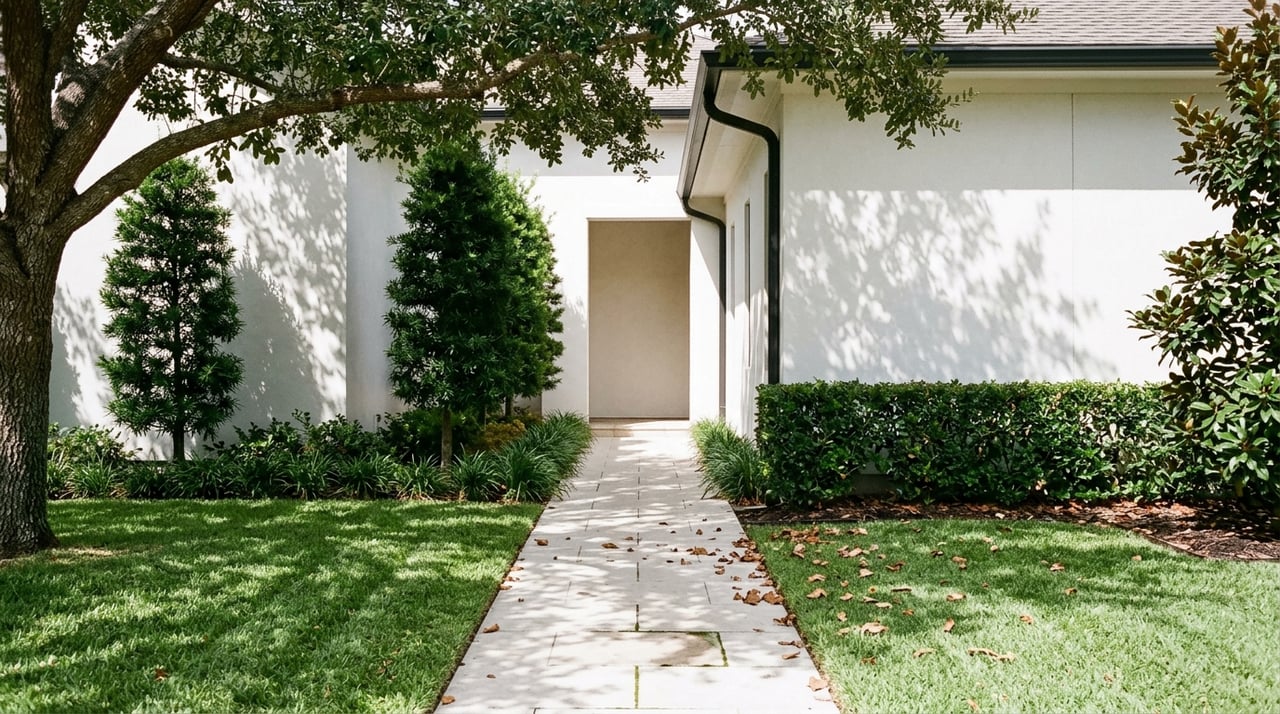
Before a single sheet of new construction drawings gets stamped in West University Place, three other things have to clear first. The trees have to be surveyed and their protection fencing installed and inspected. The sewer disconnect has to pass. The demolition has to be finalized. Only then can the building plans be permitted. That sequence is published plainly on the city's Tree Disposition page, and it is the single most underrated line item in a West U purchase, because it sets the clock on every dollar that follows.
Most buyers comparing West U to Southampton or Braeswood never see that page. They see a price per square foot on a portal, decide the market looks expensive or irrational, and move on. What they are actually looking at is the output of an arithmetic problem being solved on the back of an envelope by five or six builders at once.
The value of an old West U house is calculated backward
West University Place is 2.1 square miles, fully built out, with its own city government, its own Community Development Department, and its own adopted codes. No new lots are coming. That single fact changes how price gets set.
When an original 1950s house comes to market in West U, its most motivated bidder is often not a family who wants to live in it. It is a builder running a subtraction:
- Start with what a finished new home on this specific block would sell for.
- Subtract construction cost, which runs roughly $1 million to $4 million depending on size and finish level.
- Subtract the cost of carrying land and a loan across a schedule of ten to twenty months from design start to move-in.
- Subtract the margin required to justify the risk.
- Whatever remains is the most that can be paid for the dirt.
Lots inside the city generally change hands somewhere between $600,000 and $1.5 million, and that residual number is the floor under nearly every original house in West U. It is why "sold at lot value" appears in listing remarks here with no apology attached.
The house is not being priced. The house is being subtracted.
Which is why price per square foot runs backward
Once you see the subtraction, the strangest number in the market resolves itself. In August 2026, the Houston Association of Realtors put the average home price in West University Place at $2,310,910 and the average price per square foot at $612. Hold that $612 against two properties that could sit across the street from each other.
| Illustrative property | Size | Price | Price per sq ft |
|---|---|---|---|
| Original cottage, sold at lot value | 1,800 sq ft | $1,100,000 | $611 |
| Completed custom new build | 5,200 sq ft | $2,900,000 | $558 |
Both figures sit comfortably inside the lot and construction ranges above. Both are plausible on the same block in the same month. And the older, smaller, unrenovated house is the one printing the higher price per square foot, because the structure has been discounted toward zero and the buyer is paying for land, entitlement, and position.
This is the mechanism that makes portal-level price per square foot close to useless in this city. A high number can mean a beautifully finished residence. It can equally mean a house nobody intends to keep.
One city, three different averages, all of them true
The second thing the arithmetic explains is why West U's published statistics move in ways that would look alarming anywhere else.
In July 2026, HAR showed the West University Place average at $2,152,300 and $571 per square foot. One month later, in August 2026, the same source showed $2,310,910 and $612 per square foot. That is a swing of roughly $158,000 in average price and $41 per square foot in thirty days.
Nothing happened to the underlying value of West U in thirty days. What changed was the mix. In a city of about 14,000 residents closing a modest number of homes each month, two additional completed new builds pull the average up and two additional lot-value sales pull it down. The average is a report on which houses happened to close, not on what any particular house is worth.
Geography compounds it. The 77005 ZIP code averaged $1,750,855 and $506 per square foot in August 2026, well below the city proper, because the ZIP reaches beyond West U's boundaries into adjacent Rice-area stock. A buyer pulling "77005 data" and applying it to a house on Tangley or Annapolis is comparing two different markets. Meanwhile the broader West University and Southside market area currently shows about 101 homes for sale averaging $1,671,395 at an average of 3,379 square feet, which tells you something about active listings and almost nothing about closings.
Three numbers. Three definitions. All of them accurate. None of them a substitute for pricing a specific lot on a specific block.
Houston's record inventory is not your market
Anyone comparison shopping right now has read that Houston is a buyer's market. In July 2026, HAR reported 40,750 active single-family listings, the highest total ever recorded by the association, with 5.5 months of inventory, a metro median of $340,000, and days on market stretching from 50 to 53 year over year.
Read one tier up and the story reverses. The Real Deal, covering that same July report, noted that sales of homes priced at $1 million and above rose 9.4 percent year over year, outpacing the middle of the market, after a 17.1 percent year over year gain in the $1 million and up segment in June 2026.
Record inventory is a mid-market phenomenon. It is not the condition governing a market where the entry ticket is the price of the dirt and the competing bidder has a construction schedule to feed.
The friction that actually moves the lot bid
Here is where local knowledge earns its keep, because two lots of identical square footage are frequently not worth the same money.
West U protects any tree ten inches or greater in diameter, measured 4.5 feet above the ground. Before any pre-construction or construction permit is issued, a Tree Disposition has to be approved by the city's Urban Forester: a survey locating every large tree on the site and in the adjacent street area, a site plan showing everything that could touch a root zone including drain, water, and sewer lines, and a written narrative on protection and treatment. Critical root zones must be enclosed in six-foot chain link for the duration of construction. Healthy trees removed must be replaced before the house can be finaled. The filing fee is $250 for large construction and pool projects and $150 for remodels and demolitions.
Layer on the rest of the West U-specific process:
- The city has adopted the 2021 International family of codes and reviews plans itself. Complex submittals requiring behind-the-counter review run roughly 10 to 15 business days when the application is accurate and complete.
- Builders working here describe a clean first submittal for a custom home clearing in about four to eight weeks, with tree or drainage review capable of adding another two to four.
- Contractors must be registered with the city and carry liability insurance naming West University Place as certificate holder, which quietly narrows the pool of vendors an out-of-area renovator can bring in.
- Physical constraints are fixed. Most lots are 50 feet wide with front setbacks of 20 to 25 feet, five-foot side yards, and a 35-foot height limit, which is why the dominant new build here is a three-story stacked plan of roughly 3,500 to 5,500 square feet rather than a wide suburban footprint.
A lot carrying several protected specimens is a different asset than a clear one at the same dimensions. So is a lot where the existing structure predates 1981 and triggers an asbestos survey ahead of demolition. Builders price these differences precisely. Sellers rarely do.
If you own an original home, this is your actual decision
The subtraction cuts both ways, and this is the part worth sitting with.
If your house is presented as a structure nobody plans to keep, the market will price it as dirt and you will collect the residual. If it is presented as a residence someone can move into, you compete against finished inventory from names like Princeton Building Group, Core Builders, Parker-Evans Custom Builders, and Covington Builders, and you get paid for condition instead of surrendering it. Southern Green Builders completed a roughly 4,100 square foot West U rebuild in June 2026 designed by Greg Swedburg of 2Scale Architects. That is the standard your listing photographs are being measured against, whether or not you chose to compete there.
The gap between those two outcomes is not a marketing question. It is a scope question, decided months before the sign goes in the yard.
The city's own ledger, briefly
Worth knowing as context rather than as a pricing input: West U City Council adopted a $56.6 million operating budget for fiscal year 2027 on August 17, 2026, along with a $54 million capital improvement plan for the year. The city property tax rate has been stepping down, from $0.229441 per $100 of value in fiscal 2025 to $0.222219 in fiscal 2026, with another decrease approved for fiscal 2027. The capital plan includes Helen's Park, a future park on a city-owned home currently occupied by tenants, and continued work on the multi-phase West Side Street Drainage Improvement Project, whose first phase is a new storm sewer trunk line running the ELPH corridor from Bissonnet south to Brays Bayou, with design by HDR Engineering.
Questions this raises
Does a renovated home ever beat a new build on price per square foot in West U? It can, and the reason is the timeline. A completed, well-finished home delivers today. A lot delivers in ten to twenty months from design start, and the buyer absorbs every month of carry, every plan review cycle, and every material decision in between. Buyers who value certainty pay for it.
Why do two identical-looking lots sell for different amounts? Protected trees, existing structure age, corner versus interior position, and buildable envelope after setbacks. The city's rules apply uniformly; their cost lands unevenly.
Should I get a survey before listing an original home? A current survey and a clear read on the large trees on your lot tell you which buyer pool you are actually selling to. That answer should drive your prep budget, not the other way around.
The number on a West U listing is never just a number. It is somebody's arithmetic, and you should know whose. Kasteena Parikh works this market lot by lot, block by block, with a design and renovation practice built to move a home out of the land-value column before it ever reaches the MLS. Request a Pre-List Consultation.