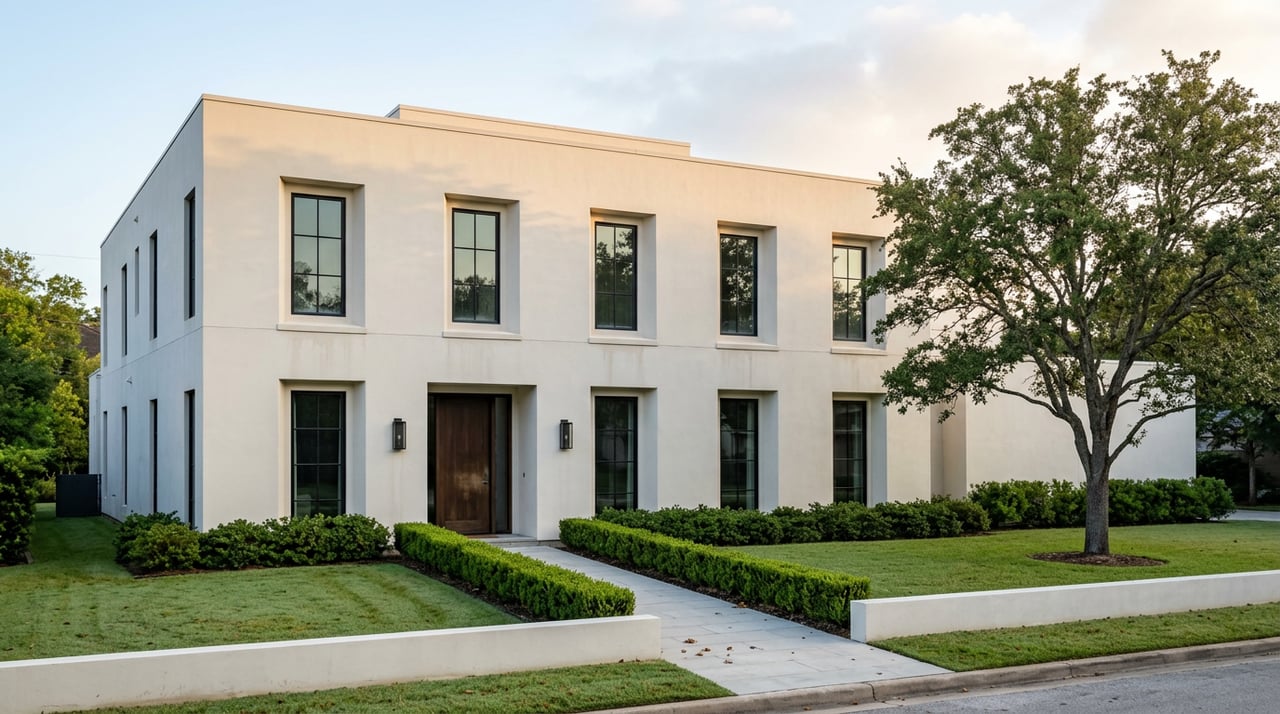
If you are shopping a teardown lot in Afton Oaks, the first surprise rarely shows up in the price. It shows up in the permit office. Houston has no zoning, so most buyers assume that means no gatekeeper. In Afton Oaks, there is one, and it isn't City Hall. Before the city will certify your building permit, you need sign-off from the neighborhood itself.
That single fact explains more about this market than any headline number does, including the one that's probably why you're reading this: recent trailing data has shown Afton Oaks' median sale price falling by roughly half in a single year. It didn't. What changed is which houses happened to close, not what any one of them is worth.
The Permit You Can't Get Until the Neighborhood Signs Off
Afton Oaks has carried deed restrictions since its development in the 1950s, and they aren't a single document that covers the whole neighborhood the way people expect. The restrictions are written section by section and sometimes lot by lot, so what applies to a house on one street isn't automatically what applies two blocks over. The Civic Club's Architectural Review Committee, staffed by elected neighborhood representatives, reviews every exterior addition, renovation, and new build against those restrictions before anything gets built. The city's own permit process requires you to certify that your construction complies with your deed restrictions, which means the practical sequence runs plans to the committee first, permit application second. Buyers who skip that order find out the hard way that the city won't backfill the approval for them.
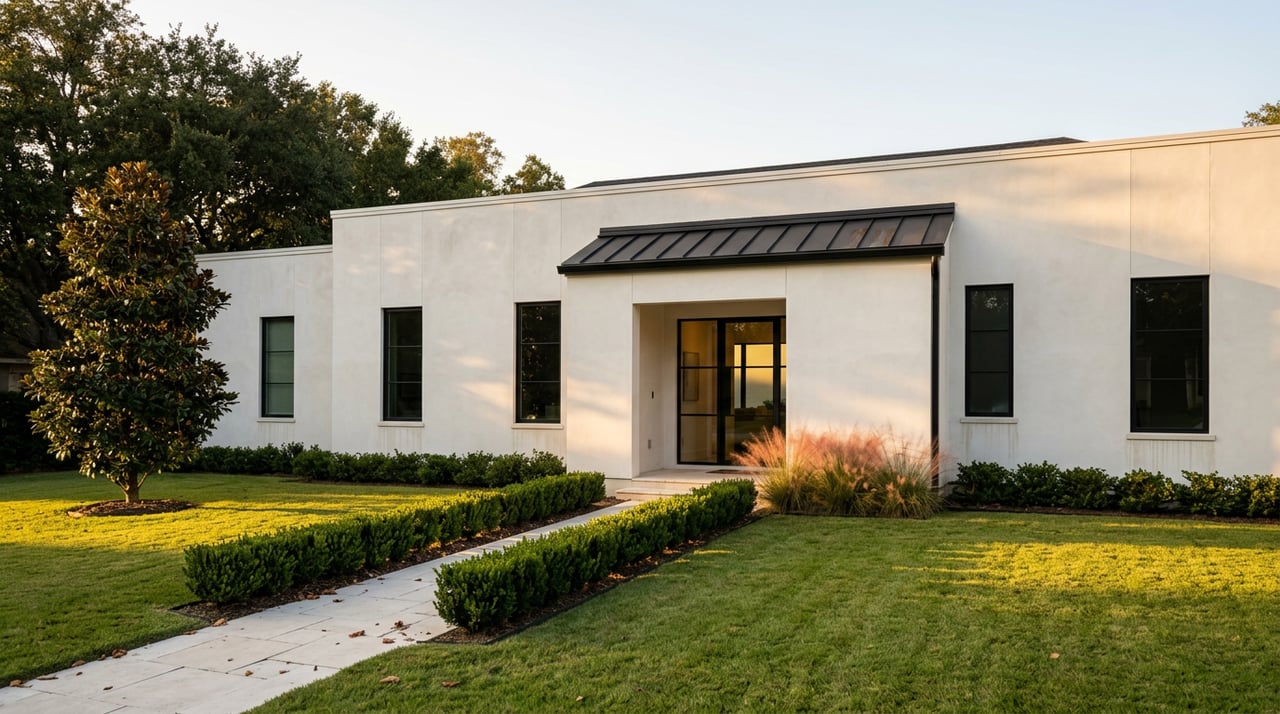
This isn't paperwork theater. It's the mechanism that has let Afton Oaks run two very different housing products side by side on the same streets for decades: a 1950s brick ranch that gets preserved and updated, and a lot sold purely for its dirt so something new can go up in its place. Both paths run through the same committee, which is why neither one has been able to take over the neighborhood entirely.
The committee itself isn't some faceless board. The Civic Club, chartered in 1955, holds its general meetings on the third Thursday of February, May, August, and November at 6:30 p.m., typically in the Crawfish Room at Ragin' Cajun, with the board meeting monthly at Narin's Bombay Brasserie or by video call. Reviewing a builder's plans in Afton Oaks means neighbors sitting down, sometimes over crawfish, and deciding what gets built next door to them.
Why Nobody Can Agree on What an Afton Oaks Home Is Worth
Here's where the friction from that review process shows up in the numbers. Look at Afton Oaks pricing across a few different windows and you get three different stories.
Over the three months ending April 2026, the reported median sale price came in near $997,000, a drop of nearly 50 percent from the same period the prior year, with price per square foot down about 27 percent to roughly $272. Only 11 homes sold that April, down from 15 the year before. Zoom out to a trailing twelve-month average instead of a three-month median, and the picture softens considerably: average sale price near $1.18 million, down closer to 10 percent. Pull a snapshot from December 2025 and the median sits at $1.05 million, with an average sale price above $1.29 million.
None of those numbers are wrong. They're measuring different things in a market too small to average cleanly. Afton Oaks has around 525 homes total. When your entire monthly sample is a dozen closings, one month of teardown-lot sales at $600,000 to $700,000 and the next month of finished new construction at $2 million or more will swing your median by a wider margin than any actual shift in what buyers are willing to pay for a comparable house. A 50 percent drop reported over a three-month window and a 10 percent drop reported over twelve months aren't contradictory data errors. They're the same underlying mix problem measured at two different resolutions.
What's Actually Selling Right Now
The current inventory tells the mix-shift story better than any aggregate stat can. A 1956 ranch on Merwin Street, 1,698 square feet on a 6,900 square foot lot, was recently under contract near $699,000, or about $412 a square foot. A few streets over on Newcastle Drive, a brand new 4,746 square foot house built in 2026 was listed at $2,199,950, or about $464 a square foot. A corner lot on Bryn Mawr in the Kettering Oaks section, nearly 14,000 square feet with an existing 3,200 square foot one-story house, was marketed explicitly around its land, described as surrounded by newer construction with room for a full rebuild.
| Property type | Example | Approx. size | List price | Price per sq ft |
|---|---|---|---|---|
| Original 1956 ranch | Merwin St. | 1,698 sq ft | $699,000 | ~$412 |
| New construction (2026) | Newcastle Dr. | 4,746 sq ft | $2,199,950 | ~$464 |
| Teardown-candidate lot | Bryn Mawr, Kettering Oaks | ~14,000 sq ft lot | Marketed for land value | N/A |
Those aren't three tiers of the same product. They're three different products that happen to share a mail carrier. Averaging them into one median tells you almost nothing about what your own budget will buy.
The building activity backs this up. Everlasting Homes Building Group has a new concrete-framed house going up on Newcastle spanning 5,561 square feet with a private elevator and a resort-style pool. Architect Travis Mattingly designed a new home for Horace Homes in the Lynn Park pocket of the neighborhood, on track for completion in mid-2026. Partners in Building has another custom two-story underway nearby. This is not a neighborhood where builders are pulling back because values fell in half. It's a neighborhood where a specific, well-documented pattern has held for years: original ranch houses trade for the value of their dirt, and that land value gets recycled into new construction, which is part of why land values here have stayed among the highest in the city even as headline sale-price averages bounce around.
That pattern is also a reversal from what the housing stock looked like a generation ago. Reporting from the early 2000s described Afton Oaks' original ranch houses as having been renovated in place, granite counters and cherry cabinets added until they rivaled new construction rather than being replaced by it. That was the norm then. The norm now, based on what's actually listing and closing, runs the other direction: buy the lot, clear it, build new. A market that used to have one dominant product now has two, and that's the reason a trailing-median calculation breaks down where it wouldn't in a neighborhood with a more uniform housing stock.
What This Actually Means If You're Shopping Here
If a portal's headline number is the only thing driving your read on Afton Oaks, put it aside and ask a narrower question: which of these two markets am I actually shopping? The renovated-ranch market, where price per square foot has been landing in the $400s on move-in-ready homes, or the new-construction market, where builders like Everlasting Homes and Horace Homes are pricing finished square footage closer to $460 to $500 and up. A median blending both tells you about neither.
If you're eyeing a lot for a rebuild rather than a finished house, build the Architectural Review Committee timeline into your calendar before you build anything else. Submitting plans to the committee is not a courtesy step. It's the step that determines whether the city will issue you a permit at all.
Kasteena Parikh works these inner-loop micro-markets block by block, matching buyers to the right side of a neighborhood's actual product mix rather than its headline average. If you're weighing a renovated ranch against new construction in Afton Oaks, or trying to figure out what a teardown lot's approval timeline really looks like, Kasteena Parikh can walk you through both before you write an offer. Request a Pre-List Consultation to start the conversation.